
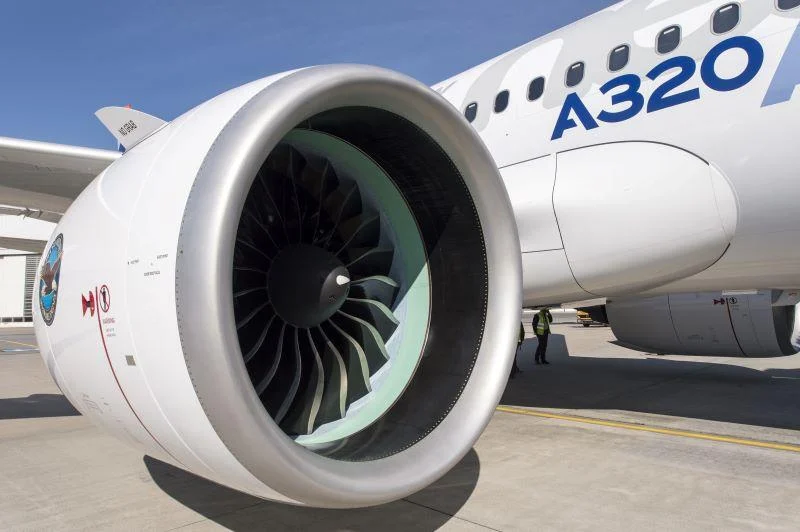
DUBAI – Pratt & Whitney (P&W) has firmly committed to evolving its current Geared Turbofan (GTF) architecture for the next generation of single-aisle aircraft, publicly rejecting the open-rotor or open-fan design championed by its chief rival, CFM International.
The decision sets a clear direction for the engine manufacturer as Airbus and Boeing prepare for the eventual successor to the popular A320neo and 737 MAX families, a platform expected to enter service closer to 2040 than 2035.
Sticking with the Nacelle
P&W, a subsidiary of RTX, announced that its engine offering for the future "Heart of the Market" segment will be a traditional ducted fan engine, maintaining the conventional installation that includes an engine housing, or nacelle, to contain the fan blades. This strategy is based on continued development of its GTF architecture, which uses a planetary gear system to allow the fan and turbine to spin at optimal, independent speeds.
The company's approach stands in direct contrast to the development path of its competitor, the joint venture CFM International (a partnership between GE Aerospace and Safran). CFM's RISE (Revolutionary Innovation for Sustainable Engine) concept includes designs for an open fan engine, which lacks a traditional nacelle, a design that potentially offers greater fuel savings due to extremely high bypass ratios.
The GTF Rationale
P&W executives have maintained that continued innovation in the GTF design will allow them to match or exceed the efficiency benefits of an open-fan design without inheriting its operational drawbacks, specifically concerning noise and installation.
Rick Deurloo, president of commercial engines at Pratt & Whitney, reiterated the company's commitment to the ducted design:
"For the next generation of airplanes, he said Pratt & Whitney was committed to keeping its existing geared turbofan architecture as well as the traditional airplane installation that includes an engine housing or nacelle to contain fan blades."
The company believes its long-term investment in the geared architecture provides a superior foundation for future improvements. Older engine development programs had also previously dismissed the open rotor, citing practical issues. As P&W’s Vice President of next-generation product family, Bob Saia, noted in an earlier discussion of open rotors:
"We never really embraced the open rotor because when we tested one on the MD-80 in the late 1980s we found there were serious noise and installation problems. With a geared engine we keep the nacelle, and the fan turns more slowly. It’s simple physics."
This pivotal engineering debate—ducted fan versus open fan—is set to shape aerospace and airline board decisions for decades, influencing the design and efficiency of global air travel for the remainder of the century.
SOURCES: FlightGlobal, Reuters